Innovation in the Unknown: Insights from PopTech Enigma 2025
- claudiotancawk
- Oct 12, 2025
- 4 min read


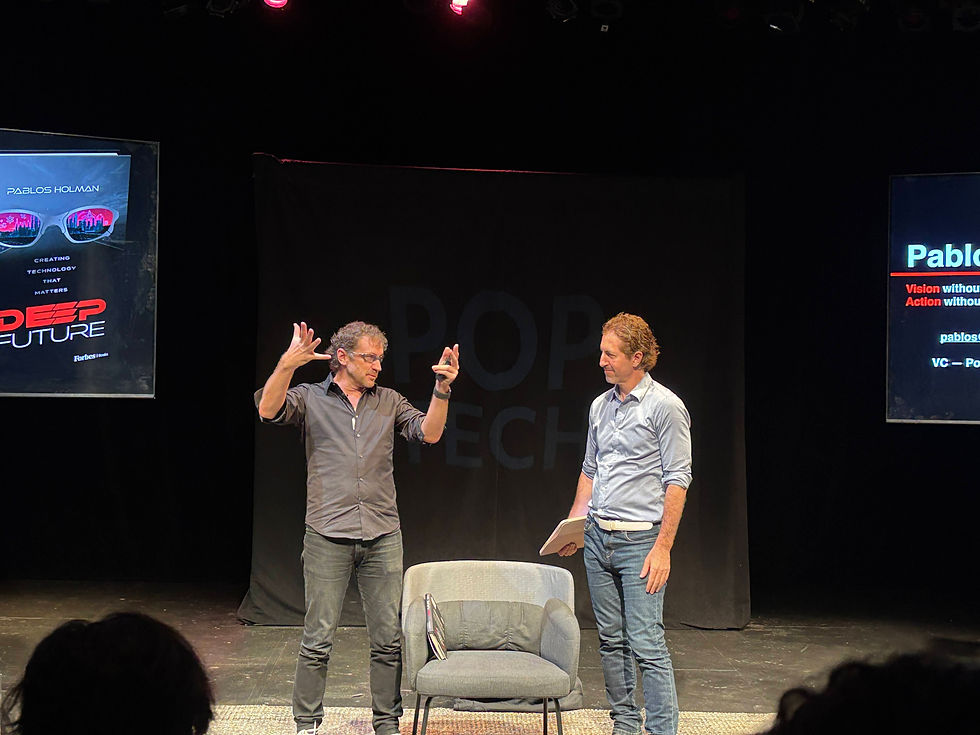

There have been many "first times" in my professional career, and last week was my first attendance at PopTech, held at the Studio Theatre in Washington, DC, from Oct. 7 to 9. Below are some of my personal impressions and considerations about the event.
About PopTech
PopTech was founded in 1996 by technology pioneers Robert Metcalfe, inventor of Ethernet, and John Sculley, former CEO of Apple. Conceived as a forum for innovators, scientists, and creatives, PopTech quickly evolved into a highly collaborative network dedicated to confronting significant societal challenges through unconventional collaboration and forward-thinking ideas.
PopTech Enigma 2025
At the event, I found what I was looking for and much more. I went to see, hear, and talk to visionaries and creative troublemakers from all over the world and from all sorts of backgrounds. The gathering convened scientists, technologists, artists, social entrepreneurs, and activists who were all set to crack the rich puzzles at the heart of our rapidly changing world. These were co-creators, codebreakers, discussions, immersion tests, and serendipitous encounters that mark the PopTech spirit.
The Ethos of Enigma: Grabbing Opportunity in the Unknowable
This year's "Enigma" theme prompted us to embrace the imbalance of an evolving world. In 2025, with technological and societal advancement accelerating, PopTech offered a creative imperative: to exploit the ambiguity surrounding all of our existence. Frontiers on the mainstage and breakouts included artificial intelligence and biosciences, focusing on climate resilience and social innovation, and presenting complexity as an opportunity to embrace unexpected opportunities and solutions.
Experiences That Transform
The genius of PopTech is its immersive quality. Attendees began with a reception at the Barrel House Cafe & Bar, where I got a taste of the fascinating people, the visionaries and disruptors who attend the event.
The next couple of days, I was in awe, fascinated, inspired, mesmerized, and constantly stimulated. Among so many visionaries, several speakers sparked a fierce sense of possibility for my future. In my opinion, some of the most memorable presentations were
- Pablos Holman, inventor and author of "Deep Future," issued a call to action for solving humanity's most significant "hardware" issues: energy, water, climate, and infrastructure. Holman's vision of tapping into deep tech and revolutionary collective imagination views technology not as an endpoint but as a starting point for world advancement—asking us all to work together in world-making innovation.
- Beth Shapiro of Colossal Biosciences leads cutting-edge de-extinction programs with the assistance of cutting-edge genetic engineering to bring back extinct creatures such as the woolly mammoth. Her vision for work also seeks to protect threatened animals and ecosystems, recasting conservation as high-tech planetary stewardship and envisioning a future where technology enhances biodiversity and human health potential.
- Eben Bayer, Ecovative's founder, illustrated the possibility of biomaterials revolutionizing the way industries operate. With his approach of cultivating mushroom mycelium into protective packaging, insulation, and wood alternatives, Bayer envisions a world with significantly less plastic, leading the way in a new design worldview that brings sustainability from idea to industrial reality.
- Meymuna Hussein-Cattan's work with the Tiyya Foundation is a personification of empowerment. She and her team build programs for immigrants and refugees, enabling economic independence and building resilient communities from chaos. Her method gives dignity to resilience and transformation, chanting that stories of resilience can be blueprints for a more compassionate, creative society.
- Dan Ariely: Shaping Risk in an Age of Rapid Change. One of the evening's highlights, behavioral economist Dan Ariely, discussed why individuals always shy away from Risk, a tendency cultivated by our far-off evolutionary programming. As Ariely explained, our brains are geared to survival in a world of immediate danger, not to cope with today's nuanced trade-offs. He challenged players to flip this risk-averse mentality, to embrace uncertainty and deliberate robustness, creating supportive networks and safety nets for innovative risk-taking to become a viable option. Ariely's results were a call to action for a world where failure is not feared, but recognized as necessary for true innovation.
These remarkable individuals stoked imagination and creativity, and there is no doubt that—with such visionaries at the helm—the next decades bring much promise.
The Strength of Community
At the heart of PopTech is a radical hospitality and intentional community-making culture. Much more than a conference, PopTech is a living, breathing community, one that extends far beyond the panels and talk schedule. Field trips, debates, and even nocturnal explorations of DC served to underscore the real value: human connection. Even lunches were hotbeds of serendipity, as spontaneous lunches sent small groups racing into Logan Circle's restaurants and cafes. The convergences revealed that the most innovative ideas tend to spark outside the spotlight, in the vibrant in-betweens of the PopTech community.
The evening parties, rinks, and serendipitous conversations often became the catalysts for new projects and enduring partnerships. Such experiences made the conference an interactive laboratory for creativity and connections.
What's Next
I will do my best to attend PotTech 2026 and become part of this community that, for nearly three decades, has thrived on convening ideas and people willing to remake our standard map of possibility. At PopTech, I had the impression that innovation is not only created by knowledge, but by the courage to venture into uncertainty, together.
As I look toward PopTech 2026, I hope to return not just as a listener but as a storyteller to share a project born at the crossroads of innovation and equity. My goal is to bring ECOS, a global digital marketplace for surgical equipment, into the PopTech conversation. If PopTech celebrates the courage to experiment in the unknown, then ECOS is precisely that: a venture built on the belief that technology and collaboration can rewrite what's possible in global surgical health.


Comments